
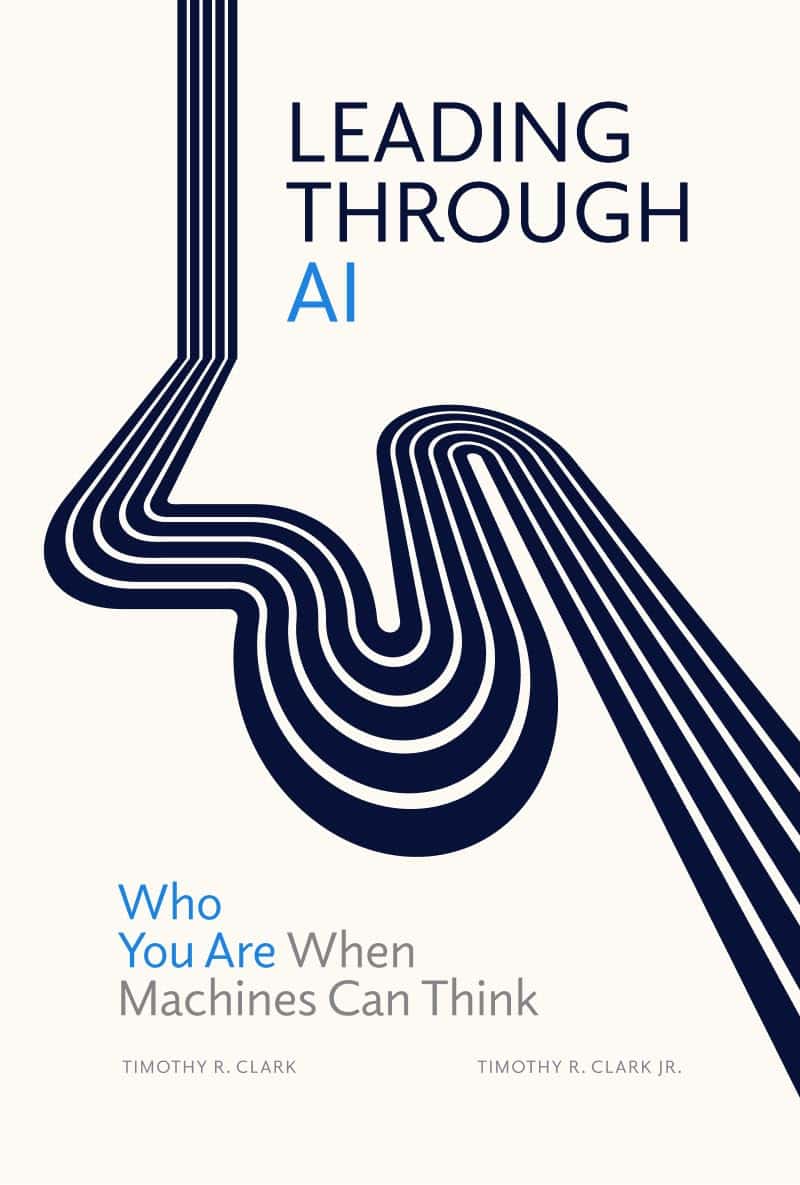
What is important about this book
For the first time in history, technology is not automating what leaders do with their hands, their schedules, or their arithmetic. It is automating what they do with their minds. As AI penetrates the cognitive layer of work, leadership faces an identity question rather than a technology question: not “What will I do instead?” but “Who am I when machines can think?”. As computational work becomes increasingly abundant, leadership is forced to concentrate around what should not be outsourced: judgment, moral accountability, trust, and the ability to choose the objectives worth pursuing.
Organizations are investing heavily in AI, yet many leaders are being asked to lead a transformation they do not yet understand. The capability gap is only part of the challenge. The deeper gap is personal before it is technological. Many organizations continue to reward the visible, analytical, procedural, and computational work that AI is rapidly commoditizing, while struggling to recognize the human capabilities that become more valuable as those computational layers fall away.
Rather than promoting AI adoption as a technology initiative, Leading through AI argues that the real challenge is not adoption, but integration. It teaches perception before prescription, helping leaders distinguish what is computational from what is evaluative, what can be automated, what should be augmented, and what must remain irreducibly human. The result is a practical discipline for redefining leadership in an era where machines can think.
Timothy R. Clark is Founder and CEO of LeaderFactor, an organizational sociologist and author of six books, including The 4 Stages of Psychological Safety.
Timothy R. Clark Jr. is President and COO of LeaderFactor, leading the company’s AI-enablement and AI transformation initiatives.
QUOTES
- “The relevant question for leaders is not whether AI can help. It’s how much of your role you’ve not yet reimagined”.
- “The human-AI partnership is more complex than a simple division of labor. The conversation between the two produces possibilities that neither could generate alone. The interaction, itself, generates something new. That is innovation”.
- “The problem is that organizations invest in technical skill first, or only, and treat the resulting utilization metrics as evidence of successful adoption”.
- “The leader has to develop the team to be able to integrate AI”.
- “Psychological Safety is the precondition for IA adoption”.
- “Those who are supposed to create psychological safety for everyone else often don’t feel safe admitting how far behind they believe they are”.
- “If you push toward adoption without being able to model the way, you induce fear and breed disillusionment”.
- “A team that has completed training and is using the tools is not necessarily a team that has adopted AI in any meaningful sense”.
- “The leaders who get the least from AI ask the smallest questions”.
- “The quality of what you bring determines the value of what you receive in return”.
- “The most significant discoveries are not the ones that make you feel clever. They’re the ones that make you feel humble. They reveal what you didn’t know you didn’t know”.
- “Strategy is the deliberate reduction of alternatives. If the reduction doesn’t produce angst, you haven’t finished the awful triage”.
- “What a leader needs is discipline”.
Structure and contents of the book
The book is structured around the Five Disciplines of AI Leadership—Define, Discover, Design, Develop, and Demonstrate—presented as a continuous learning loop rather than a linear implementation process. Each cycle returns to Define with new evidence, deeper understanding, and a new version of the leader, reinforcing the idea that AI leadership is a discipline to be sustained rather than a project to be completed.
The authors then introduce the Own Zone, Augment Zone, and Automate Zone, a framework that helps leaders distinguish work that should remain irreducibly human, work that creates value through human–AI partnership, and work that can be automated. This perspective is complemented by three distinct sources of AI value creation: Efficiency, Insight, and Innovation.
A central contribution of the book is the AI Readiness Hierarchy, which explains why AI adoption succeeds or stalls by presenting five sequential layers: Psychological Safety, Willingness, Understanding, Skill, and Identity. The model shows that each layer depends on the one beneath it, and Psychological Safety is presented as the cultural precondition for AI adoption. The framework concludes by expanding the focus from individual leaders to the organizational systems, incentives, and performance measures that ultimately determine whether human–AI partnership and AI transformation can endure.
Instructions for reading this book
This is not a book about tools, prompts, or AI theater —the performance of AI adoption without meaningful transformation. It is written for leaders whose value has long been tied to synthesis, pattern recognition, inference, and decision-making, and who are now redefining their contribution as AI makes those capabilities increasingly abundant. Read it before launching AI initiatives, while redesigning leadership roles, or whenever AI adoption appears to stall despite investment in technology and training.
Keep it open when examining what belongs in the Own, Augment, and Automate Zones, when assessing AI readiness, and when helping individuals and teams navigate the identity disruption created by cognitive automation. Its greatest contribution is connecting AI adoption with psychological safety, leadership, decision-making, and learning culture, demonstrating that meaningful transformation depends not only on technical capability, but also on judgment, trust, identity, and the organizational systems that reinforce human–AI partnership.
Perhaps the book’s most important message is that AI does not eliminate leadership—it distills it. As computational work becomes abundant, the leaders who will remain consequential are those who continually rediscover what is irreducibly human and create more value by concentrating on what should never be outsourced. After reading this book, you no longer ask whether AI can replace parts of your work—you begin to redefine what leadership means in a world where machines can think. The question will return, but this book gives you a discipline for finding the answer again and again without surrendering to the pace of change.