
WHAT IS IMPORTANT ABOUT THIS BOOK
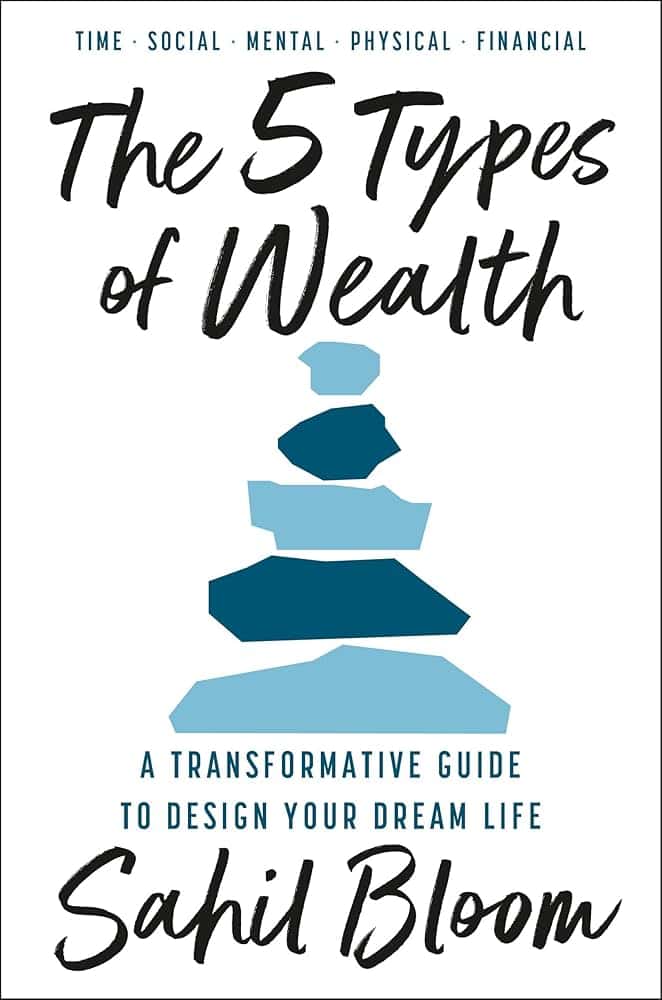
For generations, financial success has been treated as the ultimate measure of a rich life. The 5 Types of Wealth challenges this assumption, arguing that lasting fulfillment comes from intentionally balancing five interconnected forms of wealth: time, relationships, purpose, health, and money.
Modern life encourages us to pursue more—more income, more status, more achievements—as if each milestone will finally deliver fulfillment. Yet the real problem is not simply the endless pursuit of more, but the belief that money alone defines success. This book invites readers to question that assumption, redefine what truly matters, and use practical frameworks to make more intentional decisions and design a richer life.
Rather than treating wealth as something to accumulate, Sahil Bloom presents it as a dynamic system that evolves throughout life’s different seasons. The five types of wealth are designed to work together, helping readers continually rebalance their priorities as circumstances change.
Sahil Bloom is a writer, entrepreneur, and creator of The Curiosity Chronicle. Drawing on years of research, personal experimentation, and conversations with people from all walks of life, he developed the Five Types of Wealth framework to help people build a richer life beyond financial success.
Quotes
- “Outcomes follow attention. Scattered attention leads to random, ordinary outcomes; concentrated attention leads to focused, extraordinary outcomes”.
- “Every successful person will give you some variation of the same advice: Focus on the most important things”.
- “The greatest discoveries in life come not from finding the right answers but from asking the right questions”.
- “Life is about direction, not speed”.
- “Money isn’t nothing—it simply can’t be the only thing”.
- “Your wealthy life may be enabled by money, but in the end, it will be defined by everything else”.
- “What is your definition of enough?”.
- “Never let the quest for more distract you from the beauty of enough”.
- “Happiness is not a destination but a direction; how you travel through life and whom you travel with is what counts”.
- “How many moments do you have remaining with your loved ones?”
- “Proximity to people you love is worth more than any job will ever pay you”.
- “When you surround yourself with inspiring people, the journeys become more beautiful, and the destinations become more brilliant”.
- “What would your ten-year-old self say to you today?”
- “Reflecting on the past is a good way to fuel your growth, but dwelling on the past is a good way to inhibit it”.
- “You are capable of so much more than you realize”.
STRUCTURE AND CONTENTS OF THE BOOK
The book follows a deliberate progression. It begins by challenging conventional definitions of success before introducing the Five Types of Wealth as the framework for turning priorities into everyday decisions. Rather than presenting five independent topics, Sahil Bloom develops an integrated system in which Time, Social, Mental, Physical, and Financial Wealth work together to support a meaningful life.
Each wealth dimension follows a consistent structure. It opens with a guiding question, explores three core pillars, and concludes with practical frameworks and implementation guidance that help readers translate reflection into action.
Alongside the central framework, the book introduces practical tools such as the Wealth Score (a self-assessment to measure your current balance across the five dimensions of wealth), the Life Razor (to define the principles that guide your decisions), and the True North (a guiding star to clarify your long-term direction and align everyday choices with it). Together, these tools help readers evaluate their current reality, clarify priorities, and make more intentional decisions.
Rather than offering isolated ideas, the book promotes an ongoing cycle of reflection, prioritization, experimentation, and review. Its frameworks are designed to be revisited as responsibilities, relationships, and priorities evolve throughout different seasons of life.
INSTRUCTIONS FOR READING THIS BOOK
This book is particularly valuable for people navigating transitions—whether stepping into leadership, building a business, raising a family, redefining success, or simply questioning whether their current priorities still reflect the life they want to build. It will also resonate with professionals, entrepreneurs, lifelong learners, and anyone seeking a more intentional way to measure success beyond financial achievement.
Approach this book as a working manual rather than something to finish. Establish your baseline Wealth Score, revisit it regularly, and use the five types of wealth as a lens for important life decisions. Pause throughout the book to reflect, apply the frameworks to your own circumstances, and return to the exercises as your priorities evolve.
Although written for individuals, many of its ideas naturally translate into organizational contexts. Leaders who intentionally invest in their time, relationships, priorities, and long-term decisions are better equipped to build sustainable leadership practices and healthier working environments. Rather than reading the book once, return to its frameworks whenever a new season of life requires different choices. Ultimately, The 5 Types of Wealth invites readers to intentionally design a richer life—not by accumulating more, but by deciding what is truly worth pursuing.