
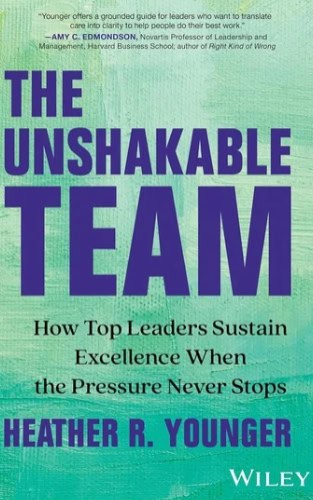
What is important about this book
Care is not the soft side of leadership; it is the stabilizing force that keeps excellence from turning into exhaustion. Leadership’s goal is not just a high-performing team, but a team that can keep performing without losing itself.
Think of your team like a canoe on moving water. The water is the reality you are leading in. The goal is not to eliminate wobble, but to build a team that can feel wobble without tipping. Unshakable is not unbreakable. It is about learning to steady the canoe together.
The future of work is faster, more digital, and more distributed. Microsoft’s Work Trend Index highlights a widening gap between productivity demands and workers’ capacity (Microsoft, 2025). Drawing on conversations with leaders and employees and the 2025 Employee Fanatix Team Culture Survey, Younger identifies a recurring pattern: teams do not break because they lack talent. They break because pressure outpaces their capacity.
Leaders shape the conditions their teams work in. By creating psychological safety, clarity, trust, and shared rhythms, they make sustainable excellence possible. The result is not only stronger performance, but stronger people. As Amy C. Edmondson, Novartis Professor of Leadership and Management at Harvard Business School, writes in her endorsement: “Younger offers a grounded guide for leaders who want to translate care into clarity to help people do their best work.”
HEATHER R. YOUNGER is a workplace culture strategist, author, keynote speaker, and Founder and CEO of Employee Fanatix, a consulting firm specializing in listening, trust, and caring leadership.
Quotes
- “Unshakable doesn’t mean unbothered. It means unbroken.”
- “Many leaders mistake urgency for clarity, and the team feels it as whiplash. Under pressure, leaders talk more, ping more, meet more, and change priorities more, but clarity goes down.”
- “Never enough is what happens when excellence is not defined and protected. Define it, protect it, then give the team permission to execute with confidence, not fear.”
- “In rough water, the most dangerous thing is not the wave, it is the silence. When people trust that their voice will be met with steadiness and care, they call the wobble early, adjust together, and keep the canoe upright. That is what psychological safety gives a team, the courage to tell the truth in time.”
- “Feedback under stress is where a lot of leaders freeze. […] But here is the truth: silence is feedback too. And under pressure, silence usually gets interpreted as disappointment, danger, or rejection.”
- “Under pressure, teams do not leave because the work is hard. They leave because they feel alone inside the work.”
- “When conflict becomes personal, the canoe doesn’t just wobble, it starts to take on water. Your job is not to eliminate hard conversations. Your job is to keep them human enough that the team can stay in the boat together and keep moving forward.”
- “Change is inevitable. Whiplash is not.”
Structure and contents of the book
Before reading the book, we recommend completing the Unshakable Team Stability Scan, a free survey (available in English – take the scan here) that identifies your Team’s strengths and weaknesses across the five sections of the book, known as Zones. This will help you approach the book with a clearer focus. The Canoe Map is the central organizing principle of The Unshakable Team, structured around five Zones and 15 chapters.
Zone 1 – The Shoreline: Purpose and Priorities (Chapters 1–3) focuses on leadership steadiness, priorities, and North Star values and norms that guide team behavior.
Zone 2 – The Crew: Trust and Care (Chapters 4–6) explores trust, belonging, and psychological safety to speak up, admit mistakes, and challenge ideas.
Zone 3 – The Canoe: Systems and Structure (Chapters 7–9) addresses ownership, decision rights, and operating rhythms that support execution and recovery.
Zone 4 – The Signal: Communication and Connection (Chapters 10–12) covers communication standards, feedback, and connection under pressure.
Zone 5 – The Water: Culture and Conditions (Chapters 13–15) examines early warning signs, conflict, and change without whiplash.
Each chapter offers behaviors to practice and a paddle—a practical tool such as reflection questions, to-do lists, checklists, pre-project reflection questions, or decision-making maps. “Back to the Canoe” reflections, decision matrices, and the Steadiness Index™ Assessment (take the assessment here) support practical application and progress tracking. Unlike the Unshakable Team Stability Scan, this assessment is not free and costs USD 29.99.
Instructions for reading this book
This book is for people managers, team leaders, executives, and those who coach and consult them, particularly in environments characterized by pressure and uncertainty. Resilience helps teams bounce back. Steadiness helps them lead while the pressure is still unfolding.
This is not a book about doing more, but about building systems that make performance sustainable. Use it as a navigation guide, not just a book to read. Bring its tools into team meetings, choose behaviors to practice, and create a shared language for navigating pressure.
Start with the Unshakable Team Stability Scan to identify where your team is strong and where it wobbles. Choose two or three actions for the next 30 days, make them visible, invite feedback, and repeat. Wobble is feedback, not failure. Silence, frustration, conflict, or disengagement can be early warning signs. Learn to recognize them and respond rather than ignore or punish them.
An unshakable team is not a team that never wobbles, but one that has learned to steady itself together, even when the pressure never stops. The real challenge of leadership is not to eliminate difficulties, but to create the conditions where people can keep doing their best work without burning out.